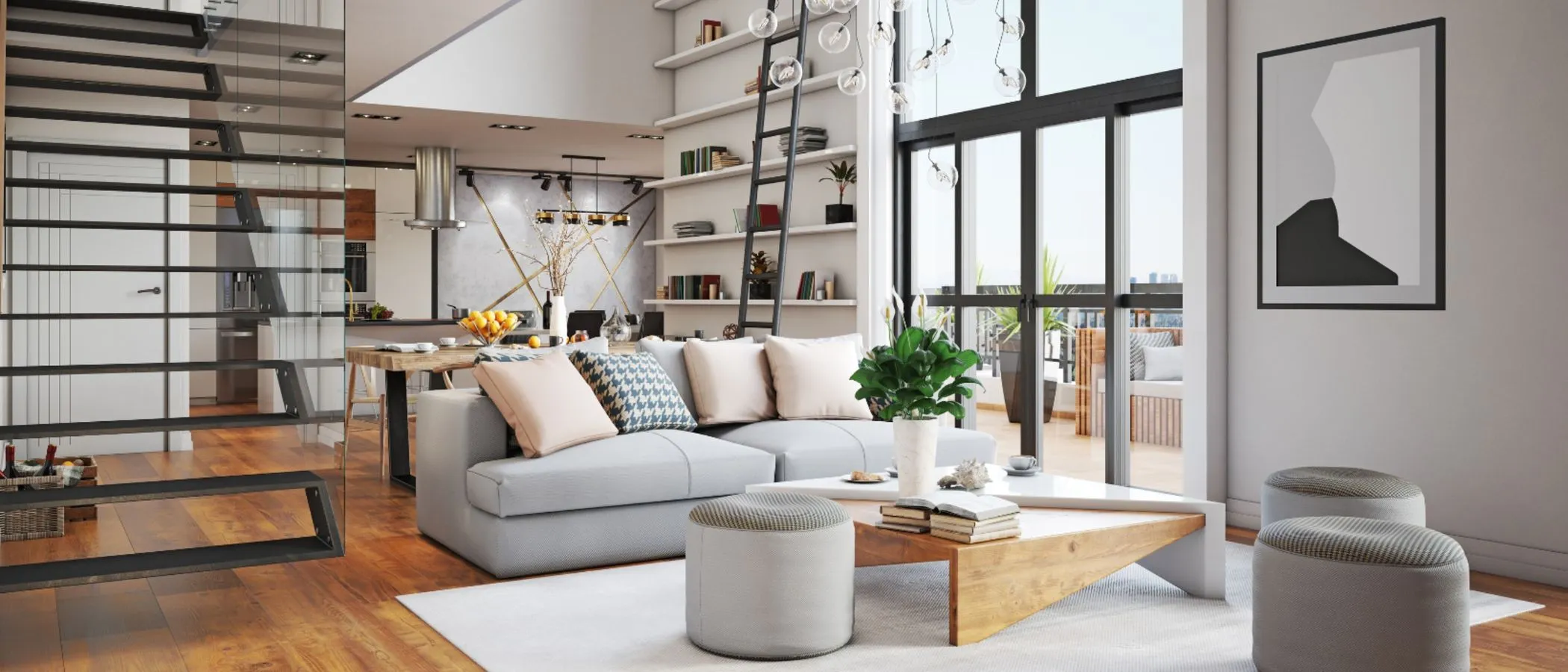
High Ceilings: The Space That Expands Your Mind
Have you ever noticed that there are places where you walk in and, without knowing why, feel your chest open up? And others where, even though they’re beautiful, your body seems to shrink? The difference is rarely in the décor or the furniture. It lies in the air above your head—that invisible space that, without you realizing it, shapes how you think, work, and rest.
The height of a ceiling is one of the quietest and most powerful variables in our experience. It acts before reason, directly on emotion. And understanding this completely changes the way we choose where to live.
What science says about the space above your head
Environmental psychology research has been studying for decades how the proportions of spaces affect human behavior. One of the most cited studies, conducted by researchers at the University of Minnesota, showed that people exposed to higher ceilings tend to display more abstract, creative, and possibility-oriented thinking, while low-ceiling environments favor more concrete reasoning focused on immediate details.
The explanation is fascinating: our brain subconsciously associates physical space with mental freedom. When the environment offers openness, the body relaxes, breathing deepens, and the mind opens up. When space feels compressed, the nervous system interprets it as a restriction—and responds with tension, anxiety, and a vague sense of limitation, even if you’re sitting comfortably.
That’s why high-ceiling living rooms are so sought after for gatherings and decision-making moments. It’s not just aesthetics. It’s physiology.
What happens to your body in an open space
When you enter a space with generous ceiling height, a nearly imperceptible sequence of responses unfolds:
Your breathing deepens. The body understands there is room to expand, and that reduces built-up tension.
Your posture straightens. Open environments invite you to lift your head and open your shoulders.
Your gaze rises. And the simple act of looking up activates a sense of possibility and hope.
Your mind slows down. With fewer constricting stimuli, the brain leaves alert mode and enters creation mode.
The opposite is also true. Rooms with low ceilings and tight proportions keep the nervous system in a state of constant micro-alertness. You may adapt—but the cost is a quiet, accumulating fatigue that builds day after day.
Solutions that minimize the problem
If you already live in a lower-ceiling space, the good news is that there are ways to enhance the feeling of spaciousness without renovating the structure:
Prioritize natural light. Light is space’s best ally. Sheer curtains, strategically placed mirrors, and light colors make the ceiling feel higher to the eye.
Reduce visual clutter. Fewer objects, less visual noise. Well-curated emptiness is what creates breathing room.
Embrace verticality. Tall shelves, floor-to-ceiling curtains, and pendant lights elongate the perception of the room.
Integrate spaces. Environments that connect visually feel larger and more fluid.
But there is one truth that no decorating technique can replace: the original proportions of a property define the ceiling of your well-being. You can soften, optimize, and beautify—but structural spaciousness is an attribute born with the design.
Why this matters when choosing your next home
When visiting a property, most people look at the furniture, the finishes, and the size of the rooms. Few notice what’s above all that: the ceiling height and the proportion of the spaces.
These two elements together define how you will live in that space—not just occupy it. They influence your mental clarity, the quality of your rest, and even the way you welcome the people you love.
A home where the mind finds its horizon
It is exactly this criterion that guides my curation. I look for properties that pass a special filter of light, flow, and well-being—spaces that overflow with life and invite the body to take a deep breath.
And with that perspective, I present a home that embodies all of this: a gated-community residence in Mantiqueira, with double-height ceilings that transform the living room into a true temple of spaciousness. There are more than 10,000 square feet of area, with a mezzanine, a home theater that can be converted into a bedroom, a fireplace, a private spa, and a balcony that extends outward, where sunset becomes part of the décor.
There, the space above your head is not just architecture. It is a permanent invitation to slow down, breathe, and reconnect with what matters most.
If you feel the time has come to live in a place where your ideas have room to grow—and where your mind can find its horizon—I would love to introduce you to this home.
Shall we talk? Your safe haven is waiting for you.
Your luxury lifestyle journey begins with direction.